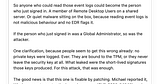
I have a few points which I want to make here :
firstly, this below is not a correct understanding of How PowerBI works and whether any code is written or not.
As many of you might already know (but I didnβt!!), traditionally, PowerBI has been a βvisual dashboarding toolβ, which means that βdevelopersβ donβt really write code but actually drag and drop widgets on a screen. There is a complicated and proprietary PBIX format for storing the dashboards, and these are binaries that cannot be read by anything / anyone but PowerBI itself.
PowerBI uses different technologies for the different layers:
1.Data Ingestion & Cleaning - something called M code or M Query - which is Microsoft proprietary SQL lite version for connecting to data sources and doing basic cleaning before you ingest ( M can be used within Excel in the same way) - there is some M code to be written here 2. Data Transformation - Once the data is in you use something called DAX to create measures and calculated columns. This is done in DAX which takes in attributes and you can specify simple logic ( though you can write complex logic if you want)
3. Data Visualization - Finally once the attributes are in the form you need, you create visuals and you format them and can also do some conditional formating and all the other stuff like visual level filtering - there is no code in this layer but needs a through understanding of the underlying two layers
So in summary to have a fully automated functional dashboard - you do have to write code which is M query and DAX. and it is not trivial.
coming to your second assumption that ..."They work less well when your customer teams realise that they are incompatible with LLMs and vibe coding" - basically that no code = no text to train on. That is not true. Ever since my teams got reduced, I have been vibe coding PBI dashboards from scratch and it is as good for that purpose as say SQL or PySpark which I also use LLMs for.
The problem that this new update in PBI is solving is the SDLC one. essentially all the code is on the PBIX file ( which you can't read if you dont have PBI for desktop) . There is no common code-repo structure where all the code resides and which can be checked-out, no branch and master setup and so on. code quality is a huge problem. The way current teams try to solve this is to keep the M code and DAX layers as 'thin' as possible - essentially shifting all the data transformation to the backend system with proper SDLC setup and just the visual layer in the PBIX file.